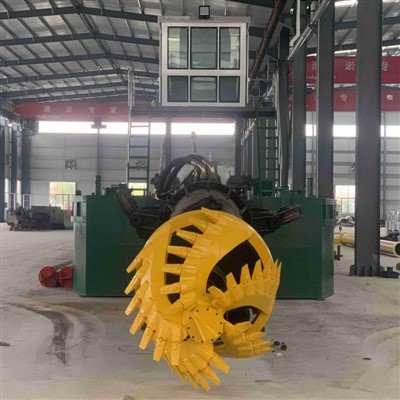
In the world of marine engineering and construction, marine dredgers play a pivotal role in various projects, from port expansion and channel deepening to coastal protection and environmental restoration. A crucial aspect of a marine dredger's operation is sediment classification. Understanding how sediment classification works is essential for optimizing dredging efficiency, ensuring environmental compliance, and achieving project goals. As a leading link text: Marine Dredger supplier, we have in - depth knowledge and experience in this field, and in this blog, we will explore the process of sediment classification in marine dredging.


The Importance of Sediment Classification
Before getting into the details of how sediment classification works, it's necessary to understand why it matters. Different types of sediment have distinct physical and chemical properties, which can significantly impact the dredging process. For example, cohesive sediments like clay and silt tend to stick together, requiring more powerful cutting and suction mechanisms compared to non - cohesive sediments such as sand and gravel.
Moreover, sediment classification is also crucial for environmental management. Some sediments may contain contaminants such as heavy metals, oil, or industrial pollutants. Identifying these contaminated sediments helps in proper handling, disposal, or treatment to prevent environmental degradation. Additionally, knowing the sediment type can assist in predicting the behavior of the dredged materials once they are deposited at the disposal site, ensuring long - term stability and minimizing potential ecological impacts.
Methods of Sediment Classification
Visual Inspection
The simplest and perhaps the most primitive method of sediment classification is visual inspection. On - site engineers or surveyors can collect sediment samples from the dredging area using sampling tools like grab samplers or core samplers. By observing the color, texture, grain size, and consistency of the sediment, they can make a preliminary classification. For instance, sand usually appears granular and is free - flowing, while clay has a smooth, sticky texture.
However, visual inspection has its limitations. It is highly subjective and can only provide a rough estimate of the sediment type. Fine - grained sediments may be particularly difficult to distinguish accurately just by sight, and it is almost impossible to detect contaminants or minor variations in sediment composition through visual means alone.
Grain - Size Analysis
Grain - size analysis is a fundamental and widely used method for sediment classification. This process involves separating sediment particles based on their size and then determining the percentage of each size fraction. There are several techniques for grain - size analysis, with sieving and sedimentation being the most common ones.
Sieving is used for coarser sediments. The sediment sample is passed through a series of sieves with different mesh sizes. Each sieve retains particles larger than its mesh opening. By weighing the sediment retained on each sieve, the percentage of particles within different size ranges can be calculated. For example, particles retained on a 2 - mm sieve are considered gravel, while those passing through a 0.063 - mm sieve are typically classified as silt or clay.
Sedimentation, on the other hand, is suitable for finer - grained sediments. It is based on the principle that sediment particles in a suspension settle at different rates depending on their size, shape, and density. By measuring the change in sediment concentration at different depths and times, the size distribution of the sediment can be determined. This method is often used in combination with sieving to provide a comprehensive grain - size analysis of the sediment sample.
Geotechnical Testing
Geotechnical testing provides valuable information about the engineering properties of the sediment, such as its shear strength, compressibility, and permeability. These properties are closely related to the sediment type and can help in more accurate classification.
One common geotechnical test is the vane shear test, which measures the shear strength of cohesive sediments. In this test, a vane is inserted into the sediment, and a torque is applied until the sediment fails in shear. The shear strength value obtained can give an indication of whether the sediment is soft clay, firm clay, or another type of cohesive material.
Another important test is the consolidation test, which assesses the compressibility of the sediment. By subjecting the sediment sample to a series of increasing loads and measuring the resulting settlement, the consolidation characteristics of the sediment can be determined. These characteristics are useful for predicting how the dredged sediment will behave when it is placed at the disposal site.
Chemical and Mineralogical Analysis
Chemical and mineralogical analysis can provide detailed information about the composition of the sediment, including the presence of contaminants and the types of minerals present. Techniques such as X - ray fluorescence (XRF) can be used to determine the elemental composition of the sediment, while X - ray diffraction (XRD) can identify the mineral phases.
For environmental purposes, chemical analysis can detect the presence of heavy metals like lead, mercury, and cadmium, as well as organic pollutants such as polycyclic aromatic hydrocarbons (PAHs). If contaminated sediments are identified, appropriate measures can be taken, such as treating the sediment on - site or disposing of it at a designated hazardous waste facility.
The Role of Technology in Sediment Classification
Remote Sensing
Remote sensing technologies, such as satellite imagery and aerial photography, can provide a broad - scale view of the dredging area and help in identifying different sediment types based on their spectral characteristics. Different sediment types reflect and absorb light in unique ways, allowing for the creation of sediment maps. This can be particularly useful for large - scale dredging projects where manual sampling may be time - consuming and costly.
Sonar and Acoustic Techniques
Sonar and acoustic techniques are commonly used to map the seabed and classify sediments based on their acoustic properties. Multibeam echosounders can provide high - resolution bathymetric data, which can be used to identify sediment features such as sand waves, mud flats, or rocky outcrops. Additionally, sediment classification systems based on acoustic backscatter can distinguish between different sediment types by analyzing the strength and pattern of the acoustic signal reflected from the seabed.
How Our Marine Dredgers are Adapted to Different Sediments
As a link text: Marine Dredger supplier, we understand the importance of sediment classification in optimizing dredging performance. Our dredgers are designed to handle a wide range of sediment types.
For example, our link text: 12inch Cutter Suction Dredger is equipped with a powerful cutter head that can effectively break up cohesive sediments like clay and silt. The cutter head rotates at high speed, cutting through the sediment and making it easier to suction up. The suction system is designed to handle different particle sizes, ensuring efficient removal of the dredged material.
Our link text: Hydraulic Cutter Suction Dredger offers even greater flexibility. It uses a hydraulic system to control the cutter head and other components, allowing for precise adjustment of the dredging parameters based on the sediment type. Whether it's soft mud or hard - packed sand, our hydraulic cutter suction dredgers can be customized to deliver optimal performance.
Making the Right Decision for Your Project
If you are planning a marine dredging project, accurate sediment classification is the first step towards success. Our team of experts can assist you in conducting comprehensive sediment surveys using the latest techniques and technologies. We can provide detailed sediment reports that will help you choose the most suitable dredging equipment for your project.
Once you have a clear understanding of the sediment type and properties, we can guide you through the selection process of our marine dredgers. Our goal is to ensure that you get the most efficient and cost - effective solution for your dredging needs.
If you are interested in learning more about our marine dredgers or want to discuss your project requirements, please feel free to contact us. We are ready to provide you with professional advice and support to help you achieve your project goals.
References
- ASTM International. (20xx). Standard test methods for particle - size analysis of soils. ASTM D422.
- US Army Corps of Engineers. (20xx). Geotechnical and environmental engineering manual.
- Gibbs, R. J. (1977). Mechanisms controlling world water chemistry. Science, 196(4286), 1088 - 1090.