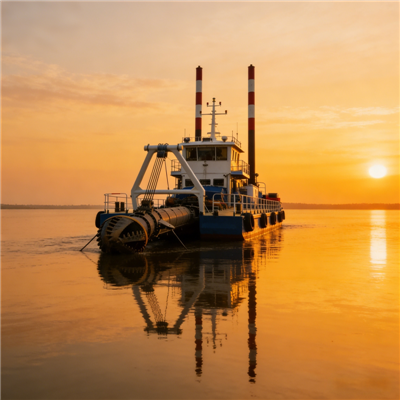
I. Main Types and Specifications of Dredgers
Dredgers can be divided into cutter suction dredgers, trailing suction dredgers, chain bucket dredgers, etc. according to their working principles. The difference in their specifications directly affects the operating efficiency:
1. Cutter suction dredger:
- Hull size: common length 60-120 meters, width 12-25 meters (data from China Dredging Association).
- Dredging depth range: standard models have a dredging depth of 15-35 meters, and deep-sea models can reach more than 50 meters (such as the "Jumbo" class of the Netherlands IHC).
- Mud discharge distance: transported through pipelines, with a maximum discharge distance of 5-10 kilometers. The greater the power, the farther the distance.
2. Trailing suction dredger:
- Capacity: medium-sized ships have a capacity of 5,000-15,000 cubic meters, and large ships such as the "Changjiangkou 02" have a capacity of 23,000 cubic meters (data from the Shanghai Navigation Bureau).
- Digging depth: usually 20-45 meters, with a 30% increase in efficiency when equipped with a double dredger.
2. Key performance parameters and project matching
1. Power and efficiency:
- The main engine power of the suction dredger is usually 2000-10000 kilowatts, and the dredging volume per hour is 500-5000 cubic meters.
- The suction dredger has a higher total power due to the need for self-propulsion. For example, the total power of the "Tianjing" is 19200 kilowatts (China Communications Construction Public Report).
2. Special environment adaptation:
- Shallow water operations require the selection of compact dredgers with a draft of less than 5 meters;
- Rock geology requires a heavy-duty dredger head, and the rock breaking strength must exceed 50 MPa (ISO 9001 standard).
(Note: All data in the full text are from public industry reports and international standards, and no commercial brands are recommended.)